The recently released 2026 State of Modern Application & AI Security Survey directly addresses these exact challenges, confirming that as attack timelines compress, relying solely on traditional pre-production security is no longer sufficient.
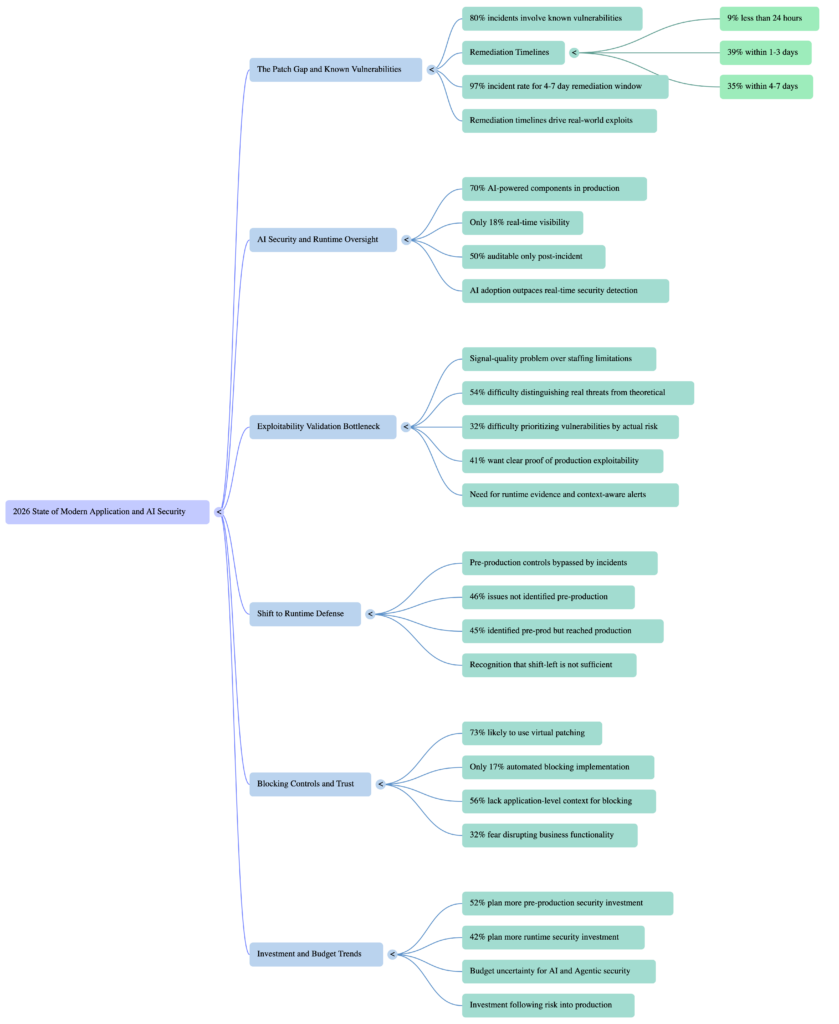
- The “Patch Gap” is the Primary Driver of Breaches: The data reveals that the greatest threat facing organizations is not unknown zero-day attacks, but known exposures that remain unresolved. A staggering 80% of organizations have experienced an application security incident involving a vulnerability their security team already knew about. The time it takes to remediate is the deciding factor: organizations taking 4 to 7 days to patch high or critical vulnerabilities face a 97% known-vulnerability incident rate, compared to 64% for those patching within 1 to 3 days. This confirms that current remediation timelines leave a window wide enough for attackers to successfully act.
- The Struggle for Proof of Exploitability: When dealing with continuous vulnerability findings, security teams are primarily bottlenecked by a signal-quality problem, not a lack of staffing. When investigating suspected production risks, 54% of organizations report difficulty distinguishing real threats from non-exploitable or low-risk findings, and 32% struggle to prioritize them by actual risk. Standard severity scores are failing to guide operational decisions; 41% of respondents stated that the single most helpful capability would be receiving clear proof that a vulnerability can actually be exploited in their specific production environment.
- AI Component Visibility is Stuck in “Post-Mortem” Mode: Regarding AI, the report highlights a severe internal visibility gap: 70% of organizations already have AI-powered application components deployed in production, yet security oversight has largely failed to keep pace. Because AI behaves dynamically and does not fit into traditional signature-based security models, only 18% of organizations have real-time visibility into these components. Currently, 50% of organizations rely on post-incident audits, meaning they can reconstruct what happened during an AI-related incident after the fact, but lack the ability to intervene and reduce exposure while the activity is actually occurring.
- The Strategic Shift Toward Runtime Defense: Because pre-production tools are not stopping breaches—with 45% of incidents involving vulnerabilities that were identified pre-production but deployed anyway—security focus is shifting to the runtime environment. Over the next 24 months, 42% of organizations plan to increase their investments in runtime security. There is also massive demand for active mitigation, with 73% of organizations expressing they are likely to adopt virtual patching to block production exploits without requiring immediate code changes. However, to trust these automated blocking tools, organizations require precise, context-aware controls that do not disrupt business-critical functionality.