Here are the detailed insights from the article regarding the strategic evaluation, execution, and ongoing responsibilities of a PCI DSS self-assessment:
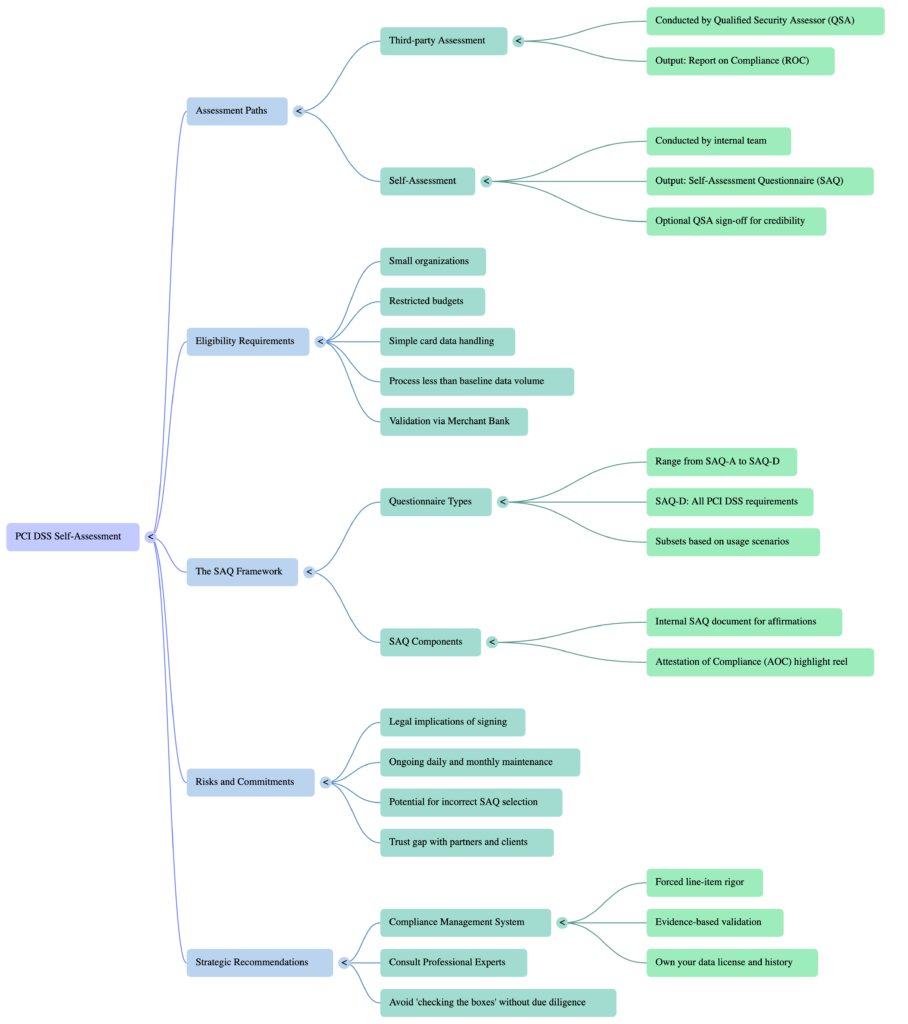
Eligibility and Paths to Compliance: In the realm of PCI DSS, organizations typically take one of two paths: a third-party assessment conducted by a Qualified Security Assessor (QSA) that results in a Report on Compliance (ROC), or a self-assessment completed by internal teams that results in a Self-Assessment Questionnaire (SAQ).
Eligibility for self-assessment is determined by transaction volume; as long as your organization processes less than a specific baseline amount of card data, you are generally free to self-assess. It is recommended to consult the Merchant Bank behind your merchant account to confirm which path you should take.
The Importance of Selecting the Correct SAQ: There are several versions of the questionnaire, ranging from SAQ-A to SAQ-D. While SAQ-D includes all PCI DSS requirements, the other versions contain various subsets of the requirements tailored to specific card usage scenarios.
- The Risk of the Wrong Choice: Some organizations try to select the SAQ that appears easiest to complete, but completing the wrong questionnaire can put the organization at significant risk.
- Because of these consequences, the author highly recommends relying on a consultant or assessor to determine the exact SAQ that fits your specific use case.
Building Credibility with the Attestation of Compliance (AOC): When self-assessing, you generate two main documents: the internal SAQ (where you sign off on your controls) and the Attestation of Compliance (AOC). The AOC acts as a “highlight reel” of your SAQ that you provide to partners and clients to declare your compliant state.
- The Trust Deficit: The primary downside of self-assessing is that you are asking outside organizations to simply take your word for it, without a third party validating your claims. Because some organizations have historically been too liberal in stating their compliance, partners may be wary of a self-assessed AOC.
- Solving the Trust Issue: To give your AOC credibility, it is recommended that you still involve a QSA or Consultant to validate your position and sign off on the document, as these professionals will not risk their reputations on unverified claims.
The Necessity of a Compliance Management System: A major danger of self-assessing is the temptation to breeze through the process without adequate rigor. When no external auditor is holding an organization accountable, it is easy to simply “check the boxes” (such as claiming you have antivirus software) while accidentally failing to meet detailed sub-requirements.
- Rigorous Validation: A compliance management system forces you to go line-by-line and attach specific evidence for every single requirement. This ensures actual due diligence rather than just checking boxes.
- Centralized Repository: Using this software creates a solid repository of your compliance history, making it much easier to onboard new consultants or partners in the future.
- Data Ownership: Crucially, the organization must own the license for their compliance management system; if you rely on a consultant’s system and later switch providers, you risk losing all of your historical compliance data.
Legal Implications and Continuous Maintenance: Ultimately, an SAQ is a formal declaration that your organization is fully compliant with all applicable PCI DSS rules, a statement that carries significant legal implications.
- Self-assessing does not give you a pass on ongoing security responsibilities.
- Maintaining PCI compliance requires a commitment to a continuous schedule of daily, weekly, monthly, quarterly, semi-annual, and annual tasks. Tools with automated operational modes can help make this continuous maintenance less risky and overwhelming.